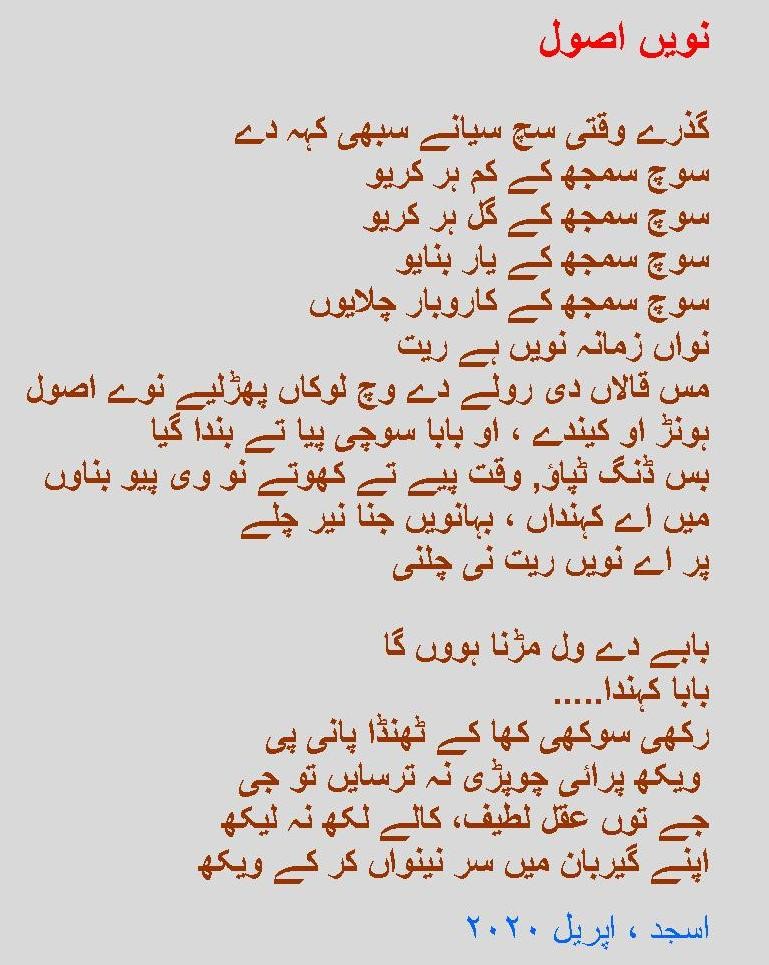
ہوُں ساٹھ کا لیکن ابھی سٹھیایا نہیں ہُوں
ہر دور سے گذرا ہوُں پر پچھتایا نہیں ہُوں
اس دور میں بھی اپنے کچھ اطوار پُرانے
اب تک وہ فراموش میں کر پایا نہیں ہوُں
پوشیدہ رکھوں خود کو میں کیوں محتسبوں سے
میں قوم کا لُو ٹا ہُوا سرمایہ نہیں ہُوں
صبر سے سہَہ لیتا ہُوں جو بیتے ہے مُجھ پر
ہر گردِشِ حالات سے گھبرایا نہیں ہوُں
تڑپیں ہیں کچھ احباب میری باتوں کو سُن کر
حق بات ہُوں کہتا کوئی دیوانہ نہیں ہوُں
خاموشی سے ہر جور و ستم سہتا رہُوں کیوں؟
انسان ہوُں بے جان کوئی سایہ نہیں ہُوں
ہمسایئے میں رہنے کا قرینہ جو نہ جانے
خوش ہُوں کہ اُس شخص کا ہمسایہ نہیں ہُوں
پھیلانا ہے روشنیِ سچ کی میری فطرت
تابندہ ہُوں آج تک گہنایا نہیں ہُوں
اسجد یہی کہتا ہے کہ جو مقبول وہاں ہو
اُس سجدے میں سر اب بھی جھُکاپایا نہیں ہُو
Asjad Bukhari 2022
جنرل محمد ضیاء الحق کا دور، جو ١٩٧٧ سے ١٩٨٨ تک پھیلا ہوا ہے، پاکستان کی تاریخ کے سب سے پیچیدہ اور متنازعہ ادوار میں سے ایک ہے۔ ضیاء کی اقتدار پر چڑھائی ایک فوجی بغاوت سے ہوئی جس نے وزیر اعظم ذوالفقار علی بھٹو کی جمہوری طور پر منتخب حکومت کا تختہ الٹ دیا۔ ضیاء کی حکومت نے پاکستان کے سیاسی، سماجی اور مذہبی منظر نامے میں اہم تبدیلیاں لائیں، جس نے ایک دیرپا اثر چھوڑا جو آج بھی ملک پر اثر انداز ہو رہا ہے۔
فوجی حکمرانی اور اسلامائزیشن
جنرل ضیاء الحق کی حکومت
کا آغاز سویلین حکمرانی کی واپسی کے وعدے سے ہوا۔ تاہم، ضیاء نے فوری طور پر اپنے اقتدار
کو مضبوط کیا، آئین کو معطل کر دیا، اور مارشل لاء لگا دیا۔ انہوں نے بدعنوانی اور
امن و امان کو بحال کرنے کی ضرورت کا حوالہ دے کر اپنے اقدامات کا جواز پیش کیا۔ اپنے
اقتدار کے دوران، ضیاء نے پاکستان کو اسلامی ریاست کے طور پر تشکیل دینے کی کوشش کرتے
ہوئے اسلامائزیشن کی پالیسی پر عمل کیا۔ اس پالیسی کے قوم کے تشخص اور سماجی تانے بانے
پر دور رس نتائج برآمد ہوئے۔
حدود آرڈیننس
ضیاء کی حکمرانی کے سب سے
متنازعہ پہلوؤں میں سے ایک ١٩٧٩ میں حدود آرڈیننس کا نفاذ تھا اور پھر آنے والے برسوں
میں اسی طرح کے مزید آرڈیننس بھی جاری کئے گۓ۔ ان قوانین کا مقصد اسلامی شریعت کے مطابق
ملک میں قانون نافذ کرنا تھا_ خاص طور پر چوری اور زنا کی حد کا نفاذ اور قتل کے جرم
میں قصاص دیت کے معاملات اور قانون شہادت۔ یہ قوانین خواتین اور انسانی حقوق کے حوالے
سے بہت سے تنازعات اور تضادات کا باعث بنے۔ اس طرح پاکستان کا قانونی نظام برطانوی
نوآبادیاتی دور کے قوانین، اسلامی فقہ اور جدید قوانین کا ایسا مرکب بن گیا کہ جس نے
قانون کو پیچیدہ اور مذاق بنا کر رکھ دیا ہے۔ مثال کے طور پر، پاکستان کے قانونی ضابطے
بعض معاملات میں مردوں اور عورتوں کی گواہی کے لیے مختلف وزن فراہم کرتے ہیں۔ دوسری
طرف یہ امتیازات مطلق بھی نہیں ہیں اور کیس کی نوعیت اور سیاق و سباق کے لحاظ سے مختلف
بھی ہو سکتے ہیں۔
افغان پالیسی اور اسکے
اثرات
ضیاء دور کی خارجہ پالیسی
کی بنیاد سرد جنگ کے دوران پاکستانی مفاد کو پس پشت ڈال کر امریکی مفادات کے مطابق
تشکیل دی گئی تھی۔ ان کے دور میں افغانستان میں سوویت یونین کی مداخلت کے خلاف پاکستان
نے امریکی امداد سے افغان مجاہدین کو مزاحمت کے لیے منظم کرنے میں کلیدی کردار ادا
کیا۔ اسکی اجرت کے طور پر ضیاء دور میں امریکہ اور دیگر مغربی ممالک نے پاکستان کو
خاطر خواہ فوجی اور مالی امداد فراہم کی- جرنل ضیاء نے افغان پالیسی بناتے وقت پاکستان
اور افغان سماج پر اسکے خطرناک اثرات کی طرف کوئی توجہ نہ دی- اس پالیسی کے سبب دونوں
ممالک میں بنیاد پرستی اور مسلح عسکریت پسندی کے رحجانات کو فروغ ملا جس کے منفی اثرات
سارے سماج کو آج بھی تباہ کررہے ہیں-
جرنل ضیاء کی میراث
اور چیلنجز
١٧ اگست ١٩٨٨ کو ایک طیارے
کے حادثے میں جنرل ضیاء کی غیر متوقع موت نے انکی حکومت کا خاتمہ کر دیا۔ لیکن انکے
دور نے پاکستان میں سیاسی عدم استحکام؛ مذہبی انتہا پسندی؛ فرقہ واریت کا جو ماحول
بنایا وہ ابھی تک جاری ہے اور اسکو زائل یا انڈو کرنے کی کوئی سنجیدہ کوشش نہیں کی
جا سکی- ضیاء دور نے پاکستانی سیاست میں ١٩٥٨ سے جاری فوج کے کلیدی کردار کی غلط روایت
کو مزید استحکام دیا اور بدقسمتی سے انکے بعد آنے والی فوجی قیادتوں نے بھی اسی پالیسی کو جاری رکھا ہوا ہے۔ اسلامائزیشن
کی جو پالیسیاں اس نے نافذ کیں وہ اب بھی ملک کے قانونی اور سماجی ڈھانچے کو متاثر
کرتی آ رہی ہیں۔
المختصر، پاکستان
میں جنرل ضیاء الحق کا دور ایک اہم تبدیلی کا دور تھا جس نے قوم ملک سلطنت پر انمٹ
نقوش چھوڑے ہیں۔ جرنل ضیاء کے دور نے آج کے
پاکستان کو درپیش مختلف چیلنجوں کے بیج بوئے، جن میں مذہبی انتہا پسندی، فرقہ وارانہ
کشیدگی، اور سیاست میں مذہب کا بے دریغ استعمال شامل ہے- اس کے نتیجہ میں ملک میں جمہوری اقدار اور مذہب
کے درمیان عدم توازن کا ایک پیچیدہ اور نہ ختم ہونے والا سلسلہ جاری ہے۔ افغان جہاد
کے لیے ان کی حمایت کے سبب پاکستان اور افغانستان میں مذہبی عسکریت پسندی کے ایسے رحجان
کو پروان چڑھایا گیا جسکے پرتشدت منفی اثرات پورے سماج اور معاش پر بہت نمایاں ہیں۔
لیکن سب سے پریشان کن صورتحال یہ ہے کہ پاکستان میں مقتدر حلقوں کی جانب سے جرنل ضیاء
کے دور کے خطرناک اور منفی اثرات کو زائل یا انڈو کرنے کی کوئی بھی سنجیدہ کوشش نہیں
کی جا رہی بلکہ انکے بعد آنے والی تمام فوجی قیادتوں نے ان میں مزید اضافہ کیا ہے اور
اس سبب جرنل ضیاء نا صرف زندہ ہے بلکہ پاکستان آج بھی اسی کالے دور میں رہ رہا ہے
ایک جانب صف ماتم ہے
دوسری جانب شور وحشت
اور سر تن سے جدا کی صدائیں
ام انیقہ ایسے میں سسکیاں لیتے بھی خوف کھا رہی ہے
اس کہانی میں ایک کھل نائیک بھی ہے
جس نے شائد کسی ہوس ناتمام کے سبب یہ آگ سلگائی ہو
پھر ایک ریاست بھی تو ہے، جو ماں کے جیسی کہلاتی ہے
ایسی ماں جو اپنے بچوں کے خون سے وضو کرتی ہے
ڈائینڑ ماں، انیقہ کو زندہ گاڑنے کی روایت تونے سن ہی رکھی ہے
اب کی بار تو بہت مہربانی کردی, بچی چھبیس برس جی لی
کہانی میں ایک گیرہ یہ ہے کہ، اسکے سب کردار ورد کرتے ہیں کہ
جس نے ایک انسان کو مارا، اس نے گویا ساری انسانیت کو مارا
شائد انسانی سروں کی فصل انکے لیے وبا بن چکی ہے
شائد سر تن سے جدا میں ہی انکے نزدیک انسانیت کی فلاح ہے
اسجد بخاری 24 جنوری 2022
Cultural Competency Workshop on 2020 Sept 27, 7pm
Singapore sets an example for the world on multiculturalism with its
founding principal being the integration of its ethnic and racial groups—a
decision was made at the outset to treat every race, language and religion as
equal. What can Canada and its residents learn from them? Join Asjad Bukhari
for our "Creating a Respectful Multicultural Society" Cultural
Competency Workshop on Sept 27, 7pm MST via FB Live or our website http://www.canadianculturalmosaicfoundation.com/cultural-competency-virtual-fair.html
Presenter: Asjad Bukhari, a previous resident of Singapore, is an
information management professional with a Masters in Library & Information
Science and is currently working for the public sector. He is also an amateur
broadcaster and community activist on social and human rights issues, and a
strong believer of multiculturalism and progressive viewpoint in society.
Creating a Respectful
Multicultural Society – Learnings from Singapore

Hello and good evening everyone, thank
you very much CanadianCMF for organizing this virtual cultural competency faire
and giving me opportunity for this presentation. Topics covered during these
events were very interesting and important, I learned a lot from these
sessions. Before starting my presentation,
I must acknowledge. Although I understand the importance of pluralism and
multiculturalism in modern state and I am passionate about this, but I am not
expert on Singapore Studies. I spent few years of my life in Singapore in their
National Library Board as collection development librarian and this presentation
is mostly based on my experience with that nation and based on some government
rules and policies in regard to race relation. My employer in Singapore NLB (National
Library Board) is responsible for running the network of Public and some
special Libraries. Public library is a place where people from all sorts of
life visit and working… and working in that organization I got good opportunity
to interact with variety of people.
Slide #1 Singapore
– Timeline
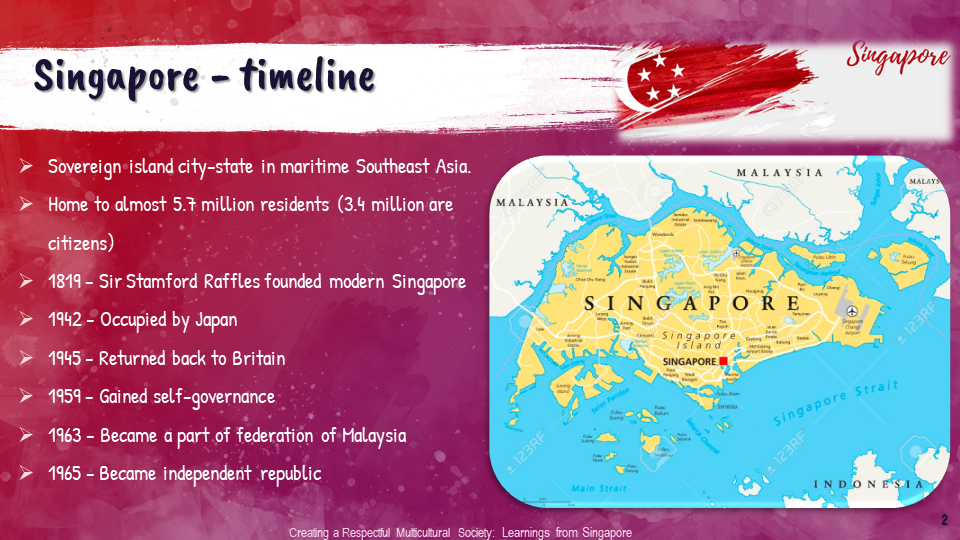
History: History of this island is stretches back to millennia but modern
Singapore was founded in 1819 by Sir Stamford Raffles as a trading
post of the British Empire. In 1867 Singapore came under the direct
control of British crown. In 1942, during the Second World War, Singapore
was occupied by Japan and following Japan's surrender it was returned
to Britain in 1945.
Singapore gained self-governance in
1959, and in 1963 became a part of the new federation of Malaysia – Ideological
differences led to Singapore being expelled from the federation two years later.
Slide #2
Republic of Singapore

Under the dynamic leadership of Lee Kuan Yew Singapore became
independent as the Republic of Singapore
on 9 August 1965
One years
before Singapore become independent country there were series of communal
race-based civil disturbances. Then couple of years after becoming an
independent country in 1969 race riots broke out again. Singapore has very
little land and not much natural resources and on top of difficult race
relations – looking at these realities political experts on that time predicted
that Singapore would not survive as sovereign nation and sooner they will
request Malaysian federation to rejoin… but this never happened! The nation
rapidly developed to become Asian Tiger and ranked ninth
on the UN Human Development Index,
and has the seventh-highest GDP per capita in the world.
Singapore is
the only country in Asia with an AAA sovereign rating from all major rating
agencies. It is a major financial and shipping hub, Singapore is
placed highly in key social indicators: education, healthcare,
quality of life, personal safety and housing, with a
home-ownership rate of 91%. Singaporeans enjoy one of the world's longest
life expectancies, fastest Internet connection speeds and one of
the lowest infant mortality rates in the world.
Fundamental reason behind economic success story of Singapore is: They successfully
turned ethnic disturbance into good race relations and healthy pluralistic
society. Human resource is Singapore’s only resource
Slide #3 The
Singapore Ethnic Mosaic:

Singapore,
because of its colonial origins, was a multicultural society long before it
became a Sovereign state and it was deeply rooted in the society. Despite its small size, Singapore has a diversity of
languages, religions and cultures. First Prime Minister and founding father of Singapore, Lee Kuan Yew have
stated that Singapore does not fit the traditional description of a nation,
calling it a society-in-transition, pointing out the fact that Singaporeans do
not all speak the same language, share the same religion, or have the same
customs. Keeping the challenges of diversity in mind founding leaders of Singapore
started with clear vision that the alternative to multi-racialism
is genocide in varying degrees.
Ethnic groups: There are four ethic/cultural groups in Singapore:
Chinese, Malay, Indian and Others
(CMIO)
Chinese: 74.3% -
Malay: 13.4% - Indian: 9.0% - Others: 3.2%. Chinese form the largest ethnic
group in Singapore.
With this kind of demographic distribution
there is great risk of majority racial group take control of power and ignoring
the right of minority groups. They overcome this threat by implementation of
real spirit of multiculturalism.
Slide #4 FROM
“DIVIDE AND RULE” TO ONE NATION

Milestones towards multiculturalism -
1964 - Series of communal riots
1965 - Attain
nationhood
1970 –
President Council of Minority Rights established
1988 – GRC
(group representation constituency) introduced
1989 – White
Paper on the religious harmony released and Housing and Development Board
introduced its ethnic integration policy
1990 –
Maintenance of Religious Harmony Act is passed and in 1993 it was implemented
1997 – Racial
Harmony Day in schools
2002 – IRCC
(Inter-Racial and Religious Confidence Circles) are introduced
2009 – The
National Integration Council is set up
2011 – The
Singapore Citizenship Journey is introduced
FROM
“DIVIDE AND RULE” TO ONE NATION
Before 1965,
Singapore was governed very differently. The major ethnic groups on the island
were each assigned their own separate communal area in which to live and work.
Interactions between ethnic communities were minimal. From colonial
government’s point of view, this policy of “divide and rule” prevented clashes
among the different groups. However, it also meant that the communities would
keep to themselves and had little opportunity to get to know each other, so, no
opportunity to develop deeper understanding and acceptance.
Singapore payed
the price for this segregation, when poor economic and living conditions and
unemployment in the 1960s – it led to ethnic tensions that boiled over into
racial violence in the riots of 1964 and 1969.
Following
Independence, the newly formed government decided to build a multicultural,
secular, meritocratic nation in
which all Singaporeans are equal before the law regardless of race, language or
religion. Singapore has come a long way from the
tense political climate and social tensions of the 1960s.
Today, despite differences in ethnicity,
religion and culture, citizens live together as one nation. Racial and religious harmony is regarded by Singaporeans as
a crucial part of Singapore's success, and played a part in building a
Singaporean identity.
Behind
this success story there is carefully crafted efforts and policies to achieve
social harmony. State of Singapore
believes that we should not take that success as granted… rather making continuous
effort to keep inter racial relations healthy.
Slide #5 Three Principles for Social Harmony

Government had three guiding
principles to achieve social harmony
1. Multiculturalism: Multiracialism is
protected under the constitution, and continues to shape national
policies in education, culture, housing, and politics. Explanation of multiculturalism in Singapore
is to bring different ethnic groups coming together as one nation, without
giving up their cultural heritage or beliefs. Major religious festivals
are public holidays.
2.
Secularism: Backed by the rule of law, the
State is secular, but not against religion. Everyone has the right to practice
their religion freely. While religious organizations are consulted in policy
matters that may have an impact on their community, although government
reserves the right to make the final decision.
3.
Meritocracy: Opportunities in public sectors
should be given based on individual merit and performance, without bias to any
race, faith or social background. While this may not result in equal outcomes, but
it guarantees that all Singaporeans have a fair chance to succeed according to
their own talent and effort.
Slide #6 Four Official
Languages

Singapore has four official languages: English, Malay, Chinese,
and Tamil; with English being the lingua-franca
or common language
Recognition of indigenous people and language:
Out of four official languages Malay is recognized
as national language of Singapore in constitution. It also
plays a symbolic role, as Malays are constitutionally recognized as the indigenous
peoples of Singapore, and it is the
government's duty to protect their language and heritage. National anthem of
Singapore – Majulah Singapura is also in Malay language.
There are newspapers radios and TV channels in all languages
Walking on the streets or interacting with Singaporeans
one can see four main cultural tendencies:
1.
Singaporeans who speak English as their
native language tend to lean toward Western culture.
2.
While those who speak Chinese as their native
language tend to lean toward Chinese culture and Confucianism.
3.
Malay-speaking Singaporeans tend to lean
toward Malay culture, which itself is closely linked to Islamic
culture.
4.
Tamil and other Indian languages speaking people are
religiously diverse but majority is from Hindu traditions.
On top of these tendencies there is collective culture and
that comes from actual lingua-franca of Singapore “the Singlish”.
Singlish is colloquial Singaporean English - a blend of local languages and
slangs and English. However, usage of Singlish is discouraged by the local
government, which favors Standard English. Despite
this, Singlish is still widely spoken across the island and viewed by most
Singaporeans as part of successful integration of different cultures exist in
the country.
Oxford English Dictionary added 19 Singlish
words such as "Lah" "sinseh" "ang
moh", "shiok" and "sabo". Singlish has been heavily influenced by Malay and Chinese.
Slide #7 Safeguards
of Multiculturalism

·
Presidential Council for Minority Rights
·
GRC - Group representation constituencies
·
Maintenance of Religious Harmony Act
1990
·
IRCC (Inter-Racial and Religious
Confidence Circles)
·
The National Integration Council
·
HDB’s (Housing and Development Board)
ethnic integration policy in housing
The
Presidential Council for Minority Rights (PCMR)
is a non-elected government body in Singapore established in 1970, the main
function of this body is to scrutinize bills passed by Parliament to ensure
that they do not discriminate
against any racial or religious community. If the Council feels that any
provision in a bill contradicts with the rights of minorities, it will report
its findings to Parliament and refer the bill back to Parliament for
reconsideration. In short PCMR is a safeguard to
ensure that the Government does not implement any law which discriminates or
disadvantages any race, religion or community.
A Group Representation Constituency (GRC) is a type of electoral division or constituency in Singapore in which teams of
candidates, instead of individual candidates, compete to be elected into Parliament as the Members of Parliament (MPs) for
the constituency. GRC scheme is a safeguard to enshrine minority representation
in Parliament: at least one of the MPs in a GRC must be a member of the Malay, Indian or another minority community of Singapore. In
addition to that, it is economical for town councils, which manage public housing estates, to handle
larger constituencies.
Actually, there were concerns in voting
patterns that more Singaporeans may voting along racial lines, which would lead
to a lack of minority representation in Parliament, so, GRCs is to guarantee a
minimum representation of minorities in Parliament and ensure that there would
always be a multiracial Parliament
instead of one made up of a single race.
The National
Integration Council (NIC) was set up in 2009 to coordinate and encourage
ground-up integration efforts through partnership between the public, private
sectors and the people. Initiatives introduced by NIC include the Community
Integration Fund (CIF) and the Singapore Citizenship Journey - these
initiatives provide opportunities for healthy interaction in communities.
INTER-ETHNIC RELATIONS: FROM TOLERANCE TO ACCEPTANCE
Good inter-ethnic and inter-religious relations is a top priority in
Singapore. They are mindful of the sensitivities of being a multicultural
society.
Beginning in the 1970s, national programmes were designed to ensure a
balanced representation of Singapore’s diverse ethnic makeup. Housing and
Development Board (HDB)’s Ethnic Integration Policy is one of that. HDB’s Ethnic
integration policy ensures that families in Singapore would live alongside
different religion and ethnicities - sharing common amenities such as
playgrounds, shops and bus stops. This is just opposite of the colonial era
norm of ethnic segregation. This policy discourages the formation of ethnic ghettos and making the daily
social experience more inclusive and diverse. This is also creating common
spaces where people during their daily lives, meet, mingle and build bonds
naturally. Over the time, this regular encounter and interaction of families
from diverse ethnicities and cultures is forming a common culture of respect,
trust, understanding and acceptance.
By the way 80% of Singaporeans
reside in HDB’s public housing estates.
Display of cultural diversity become
biggest tourist attraction of Singapore – China Town; Malay village; Little
India; Orchard Road
So, in Singapore you don’t have to give
up your beliefs and culture. However, to maintain overall harmony in society
you are encouraged to abide by common values and norms to respect other
cultural practices.
Slide #8 Holidays in Singapore

Slide #9
Cultural Celebrations & Active Days @ Work

Environment at Work Place: This
is based on what I observed during my stay in the country. Being new employee, one must go through variety of orientations
and courses for acceptable behavior and code of conducts and if you are from
overseas then there are some extra courses as well. Racial slur and jokes are unacceptable and in
case of complain – there are serious disciplinary consequences. Common areas
like lunchrooms; cafeteria and employees lounge has delegate considerations for
everyone. e.g. vegetarians/halal/regular etc. Holiday celebrations for all
existing cultures at work.
Slide #10 Not
everyone is Happy:

Not everybody is
happy - I come across several critical writings on Singapore government policies
regarding multiculturalism and among them was one article on medium.com titled:
The Myth of Multiculturalism in Singapore
written by Bella. I quote concluding remarks from that article:
“The current status quo of different races having mostly superficial
understanding of each other based on stereotypes or are closed off from each
other would be more manageable than a population with a mature understanding of
the degrees of the human condition because the latter might contest PAP’s many
policies that are designed along racial lines. Therefore, it is my belief that
the PAP government will continue to sustain the myth of multiculturalism in
order to install themselves as the guardians of Singapore’s peace and
prosperity.”
LGBT community is also not happy with present laws regarding their
rights:
For the rights of LGBT community, Singapore is making slow moves as per the
pace of society. In June 2019, at the Smart Nation Summit, Prime Minister Lee Hsien Loong repeated that Singapore
would keep Section 377A "for some time" saying, "Whatever your
sexual orientation is, you're welcome to come and work in Singapore. You know
our rules in Singapore. It is the way this society is: We are not like San
Francisco, neither are we like some countries in the Middle East. [We are]
something in between, it is the way the society is.”
Section
377A states that: "Any male person who, in public or private, commits, or
abets the commission of, or procures or attempts to procure the commission by
any male person of, any act of gross indecency with another male person, shall
be punished with imprisonment for a term which may extend to 2 years."
Section
377A remains sporadically enforced. Between 2007 and 2013, nine people were
convicted under 377A provisions.
Other
sections of the Penal Code potentiality relevant to LGBT Singaporeans include: Section 354; Section 294A
Human rights activists have been calling for the repeal of
Section 377A, arguing that it infringes on privacy, the right to life and
personal liberty, the two latter being constitutionally protected. In
2007, the Singapore Democratic Party (SDP) called for the repeal of
Section 377A
So there is always
appetite to do more… when it comes to learning from Singapore – I guess every
country has its own unique problems and situation but still multicultural
societies can learn from number of Singapore initiatives.
Since 1970s Canada also made significant moves towards multicultural
society. In 1971, Canada
adopted multiculturalism as an official policy. As result of that policy
statement: in 1982 multiculturalism was recognized by section 27 of the
Canadian Charter of Rights and Freedoms. Then Canadian Multiculturalism
Act of 1985 introduced. The doctrine
of multiculturalism rest on believe that individuals of different cultural
backgrounds can co-exist peacefully and happily in same society. It needs
understanding of each other’s cultures and traditions… then there will be
contradictions and conflicts between cultures … and through acceptance we can
move towards settlement … but acceptance should not mean to end practicing personal
values and lifestyle… as long it is not contradictory to common law.
Slide #11 – Any
Questions

Credits: Presenter: Asjad Bukhari
Special thanks to: Iman
Bukhari for the outline and Komati N. C. for helping to find the references
Photo credit – PSD
Singapore
Calgary, AB Sep. 2020


